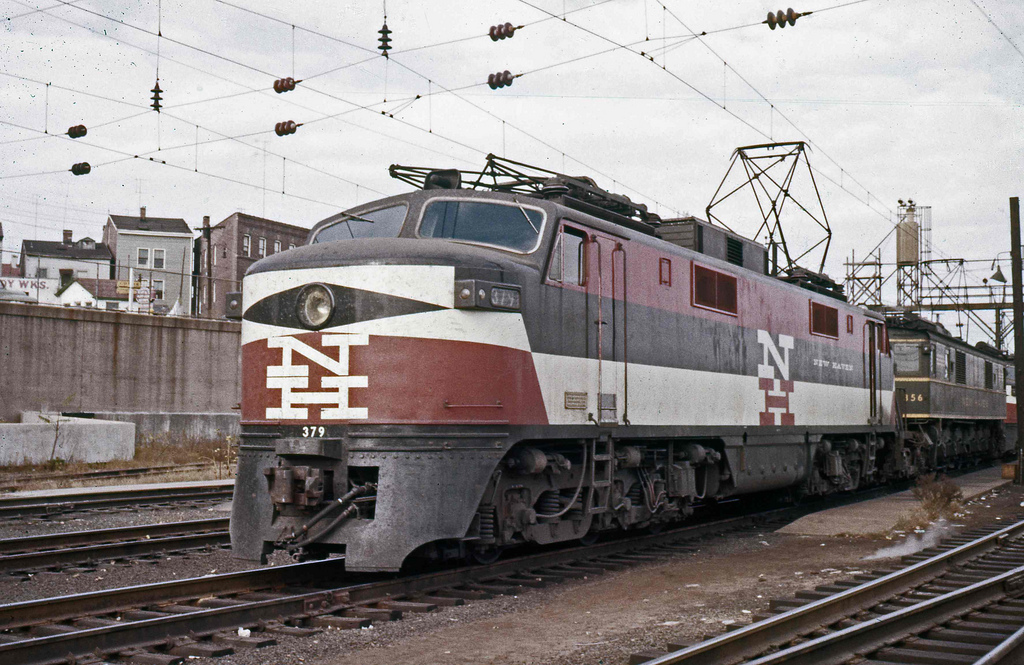
A New Haven Railroad EP-5 electric locomotive

22 January 2019

 This blog was triggered by what I think is a really wonderful picture of a New haven EP-5 on the ready-track. The other pics are all post-WWII US designed electric Co’Co’ locomotive versions that are in fact family. In judging this it should be borne in mind that Westinghouse had closed its traction-equipment doors in 1953 and Baldwin did the same in 1954. General Electric took over the job of manufacturing electric loco’s from then on, but it is absurd to think that GE didn’t vacuum up relevant Westinghouse and Baldwin traction people for their own good. With other words, Baldwin as well as Westinghouse know-how must have informed whatever General Electric did from 1954 onwards. Anyway, after the Dutch 1200 in 1950, first the New Haven EP-5 followed in 1954 and then the Chilean locomotives followed in 1960.

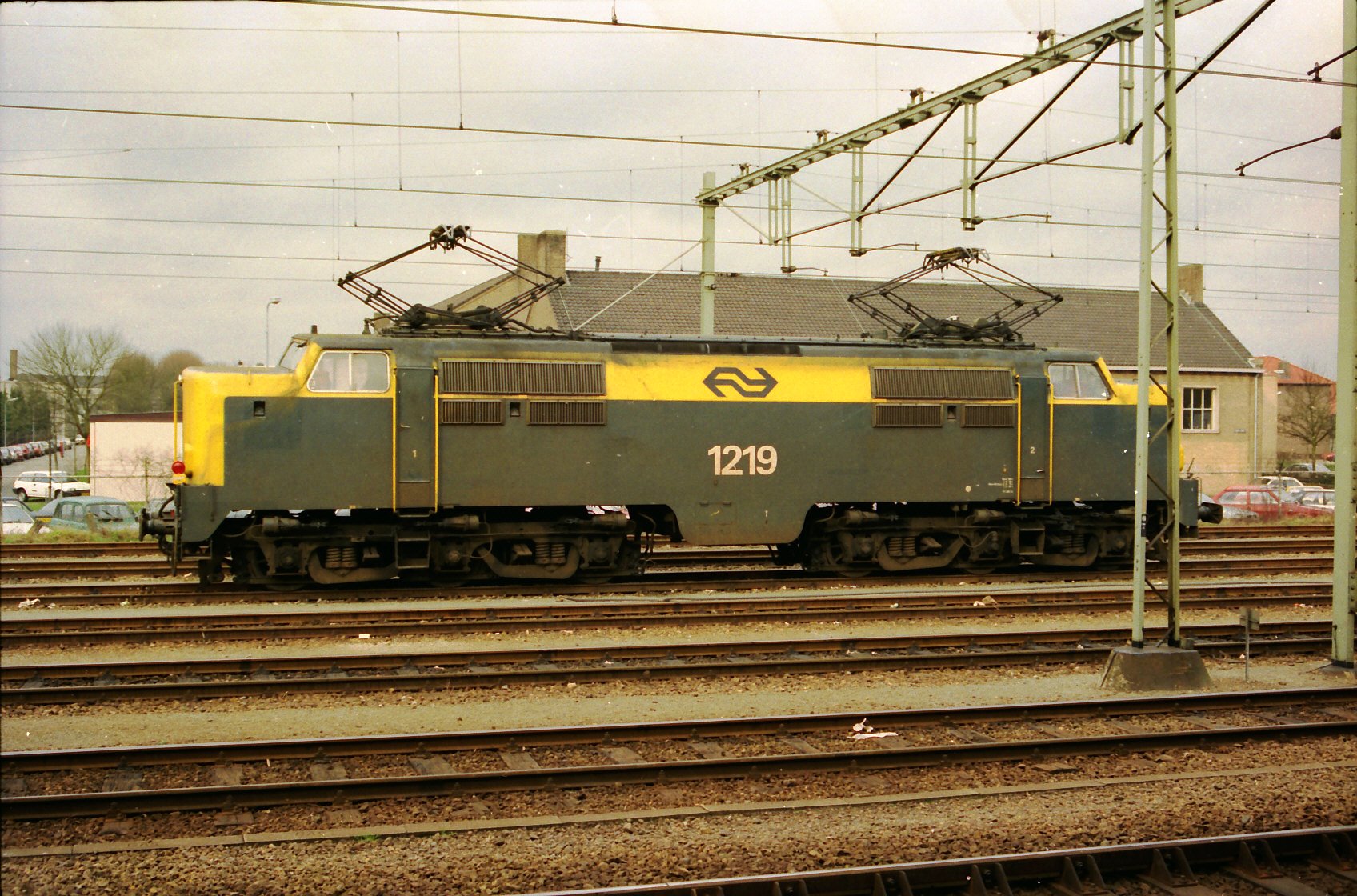
Netherlands Railways class 1200 Co’Co’
New Haven & Hartford Railroad EP-5

One of the better looking post-war US electric locomotives, the New York, New Haven & Hartford Railroad EP-5. Launched from 1954, this was a complex piece of equipment for its day. GE got the order for ten of these from a cash-strapped New Haven and in order to do the best job possible, they convened a committee of electric traction specialists (no doubt by then out-of-work Westinghouse people included) to analyse the problems with the Baldwin/Westinghouse E2c and E3b ignitron rectifier locomotives for the Pennsylvania Railroad, the “Westinghouse Rectifiers”, and look at ways to avoid running into the same problems again. One of the issues on those Westinghouse loco’s was the heat generated and the problems encountered to dispel it. Things would not be easier for the 2.98 mW proposed NH machines, which would have to deal with 11 Kv 25 Hz and 60 Hz AC as well as 600 v DC. In order to get an idea about the best lay out for these loco’s the designers came across the 1948 design for the above very similar Dutch loco’s. It was instantly clear that for the jobs proposed only a double-ender would do, as was in fact the case on all the New Haven and Pennsy electrics bar the for freight conveyance designed Westinghouse and GE experimentals of 1945. This meant, however, that like the ignitron rectifier experimentals, this AC-DC rectifier once again would be a rather well-stuffed machine, as not only would a big transformer with tap-changer but also 12 (2 per traction motor) ignitron mercury-vapour rectifiers need to find a place, as well as resistance banks to control the locomotive on the 600 V DC track in the New York area on the way to NY Central station rather than Penn station. And the six DC traction motors did their bit to generate heat, whereby on top of it all two cabs instead of one needed to be included in a none too generously spaced body. Which left no generous empty rear-end where some of the electric kit and cooling equipment could find a place. As a result these locomotives, however good they were at their job, had a tendency to overheat, especially in the Park Avenue tunnels under Manhattan, despite the powerful ventilation equipment installed that challenged the hearing of those on platforms when these machines passed by. Their nickname “Jets”, (straalvliegtuigen), says it all. And yes, more than once they set themselves alight. Their history reads like wobbling from crisis to crisis, hiding the fact that they were actually rather good at their job. Had, for instance, silicon rectifying equipment been available (or installed during an overhaul later in the 1960’s) it is doubtful that these machines would have had the problems they encountered with their installed kit. And the history of electric passenger traction on the Northeast Corridor would then have looked markedly different: it is doubtful that the GE-built Amtrak E-60 would have ever had a chance. All these machines were out of use in 1977 and by 1979 they were all scrapped. For a small but technically and design-wise very influential railroad like the New Haven it is remarkable that none of their traction appears to have been set aside for a museum. For this machine one needs to go to Chile or The Netherlands to get an idea of what they kind of looked like, for the EP-4 one needs to visit Chile or Brazil to find spin-off examples and the EP-3, one of which with number 156 is visible behind 379) is plain history to the best of my present knowledge. But, again, look at the details of number 379. The trucks are kind of similar to the regular drop-equalizer bar trucks of the 1200, but not quite. The weight of the loco is evident in the fact that extra primary coil springs were added at the very end of the trucks. For a machine with known heat-management problems, look at the (later added, after fires) comparatively small ventilation grilles in the sides. The main ventilation takes place through that box on the roof, where in the tunnels the ambient summer heat congregates as well. Find the DC pick-up shoes and shoe-fuse boxes at the inner ends of the trucks. And those little square flap-covered entrances either side of the bodyside ventilation grilles, are these the sand-filler openings? See the tightlock coupler with the brake and main reservoir pipes and the speedometer connection going up into the cap from the axlebox nearest to us. Most of all, the red/light grey and black Patrick McGinnis colour scheme that a present Dutch operator tried (but failed) to emulate on a 1200. And the Raymond Loewy set up of marker and reporting light clusters either side of the headlight. And what a lovely, clear picture; I dearly wish I could have made that.

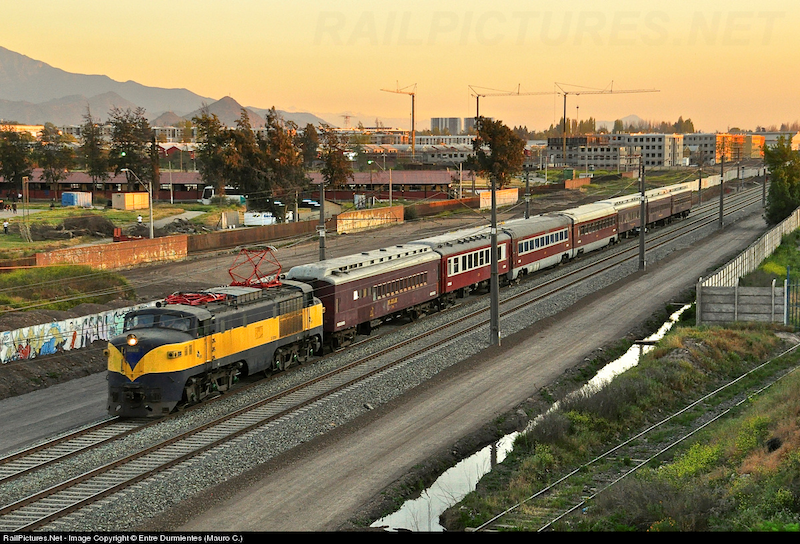
Ferrocarriles Del Estado de Chile E-32 Co’Co’

Chile, the Ferrocarriles Del Estado de Chile. The machine shown is an E-32 Co’Co’, meant primarily for freight. The Bo’Bo’ passenger variety could be seen on an earlier picture I sent of an E-30 and an E-29 (the NH EP-4 clone) awaiting their next assignment. There are a number of things that tell me that this is most likely a special, like we see them running on Netherlands Railways with the 1200. Given that a) I read that long-distance passenger rail-traffic is virtually defunct in Chile, given that b) this is clearly a site where a city is being extended into further suburbia, and c) given that the tracks have been most thoroughly done up and look spiffing, a credit to messrs Plasser & Theuer, never mind that the train is d) composed of at least three generations of suspiciously clean looking rolling stock where normally one saw trains lashed up from one type of, but much dustier, coaches, I can’t be very far amiss with that assessment. Obviously, the fact e)that someone was train-mad enough to sit there in the setting sun to take a picture of a train is a further indicator. But look at the locomotive and scroll forward and back from notably the NH EP-5. Well, this machine is Italian-built and far and wide advertised as such: General Electric or Westinghouse, let alone Baldwin, are nowhere mentioned. But look at those markerlight/reporting light clusters, the clearly US drop equalizer bar trucks, that ever so US stairway to heaven right where the PRR E2c and E3b and the RENFE 278 have it, and most of all where NS 1200 would have had it had Baldwin had its wicked way and a detail like that ventilator box on the roof. This has very little to do with Italy per se, they built absolutely completely different loco’s there. This machine has everything to do with Baldwin, Westinghouse, General Electric, the New Haven and Pennsylvania Railroads and the Italian builders just had the honour of putting the machines together. Despite their nickname “Gina Lollobrigida’s” due to their well-rounded front ends, they really are mainly New Haven EP-5’s. The history is in the book, on which I’m working now to rewrite it is English.

Three more pictures from Amy Varias

29 November 2018

Three more pictures from Amy Varias in the Strasburg PA railroad museum. Made for the book I’m touting to publishers at present, whilst I have also offered the manuscript for serialisation in the magazine “Op de Rails” (on the tracks) of the Dutch organisation for railway interested folks called NVBS. They just emailed me they like the idea, so at least we can grow interest in the book that way, which is the sort of certainty of sales that publishers crave. I can see their point, in all honesty.

Photo 1) A detail of the bogie/truck of a General Electric built Amtrak class E-60 Co’Co’ high-speed (intended) electric locomotive. We clearly spot the connection for the speedometer and possibly wheelslip monitoring equipment on the axle-box cover, with a small-mile counter with a horizontal slot to see the accumulated miles fitted behind it. I saw this very detail earlier on the truck of British Rail class 84 number 001 in Bo’Ness Scotland, incidentally, never seen that before on rail rolling stock. But yes, keeping track of the miles travelled makes sense and this is one way (from those days before satellite tracking, remember those?) to do it. Above the axle box we see the coil springs of the primary suspension between the axle and the truck frame. Travel upwards and then to the left and we spot something that looks like layers of black rubber between sheets of metal. That is what had to act as the secondary suspension between the truck frame and the 126 tons of locomotive body above it. Four of these rubber/steel sandwich “springs” per truck. Above it we see the protruding heavy cast steel support incorporated in the bolster, whilst part of the view on the spring is blocked by something sticking out without an immediately obvious function. It had one, though, that is where a yaw-damper between the body and the truck was fitted. Equipment that nowadays is standard issue on any piece of high-speed rail equipment let loose on the tracks. Anyway, this is what GE marketed as the “floating bolster”. Four of such rather squishy and in their motion uncontrollable stacked sets of rubber pancakes between sheets of metal. Another peice of later kit are the rubbery black looking bits with the two white eyes. To see that you have to go down to the bottom of the wheel and see a sort of nut with a handle sticking out to the right. If you undo that bit both sides of the wheels and axle the whole assembly holding that axle in the truck frame falls out, in fact the way to drop the axle and traction motor assembly out of the truck frame. You now see how the so-called horns, keeping the axlebox in place whilst allowing them to move up and down, work. These had to be tightened up without seizing up on the axlebox. That is what those black thingies with the white fasteners are all about. There also were motion dampers fitted between axle boxes and truck frame, but only on one side of each truck. It nevertheless didn’t save the loco for its intended job, read on.The story behind it all? Amtrak needed to desperately replace the ageing GG1 2’Co’Co’2′ machines due to plummeting reliability and paucity of spares. The usual reason to ditch ancient equipment, incidentally, is exactly that: lack of particular spares. During a quiet night-shift of moving stock around Stewart’s Lane depot in Battersea (next to the Pink Floyd four-stacked power station and the Battersea dog’s home) I’ve helped Gatwick Express mechanics fashion a wooden clamp by hand from a block of wood for that precise reason: to take the three heavy dc traction current cables from the loco on to the traction motor of one of my beloved class 73 ED’s. So new locomotives were required, and GE used the situation to put forward this class E-60 to cut the necessary delivery time to one year with the argument that European locomotives (probably better suited for 125 mph/ 200 km/h work) would require at least three years for agreement on the necessary alterations for running in the USA and most of all to get past the bureaucracy that would fight spending federal money on expensive foreign-built public transport kit. So Amtrak, in serious time-trouble, agreed to initially purchase thirty E-60’s. From day one it was clear that these machines were fine up to speeds of 50 mph, 80 km/h, but that 125 mph, 200 km/h, was outside their remit. Not only did the trucks hunt terribly, whilst powerfully accelerating the whole loco set up a fore-and-after side to side motion. Like the Pennsy P5’s did before them, it was a bit a matter of back to the future there. The derailment at Elkton MD at 106 mph/ 169 km/h due to the loco spreading the track gauge stopped running E-60 at high speeds in its tracks. NTSB came on the scene and found serious problems with the floating bolster arrangement and the weight of the locomotives. GE set to work to alter the loco’s and found that really, they’d have to put different trucks under them and cut a serious lot of weight, which basically amounted to redesigning the machines. This is what led to the invitation to test European machines and to the eventual arrival of the “Swedish Meatballs”, the EMD built AEM-7 Bo’Bo’ based on the ASEA Rc-4. Lighter, rather more powerful and eminently able to quietly run at 125 mph. A few E-60’s, among which this one, were retained and used at 145 km/h on night services. They were retired in 2003, one went to Strasburg museum where Amy took this picture.

Photo 2) Remember the black and slightly rusty Number 4800 GG1 called old rivets last ramble? This is what Raymond Loewy added; a smooth welded skin with his trade-mark streamlined reporting-light clusters either side next to the headlight and a rather fetching Burgundy green with five line gold pin-stripe livery. Remember, this is when people in the paint shop were skilled: they set this out and then painted these lines, didn’t stick them on. I also would like to point out the folded down step and the hand-holds in front of the nose door. Number 4935 belongs to the last machines built during WWII, Old Rivets 4800 was from 1937. I guess that the Army veteran next to the loco is part of the celebrations around the termination of WWI.

Photo 3) “Old Rivets” 2’Co’Co’2′ GG1 nr. 4800 in its faded black ConRail freight livery next to its Swedish designed Amtrak successor, the ASEA/ EMD AEM-7 Bo’Bo’. This machine is clearly recognisable as from European stock, but has nevertheless a lot of details one would not normally find our side of the Atlantic. On both loco’s the various stairways to heaven, on the AEM-7 up between the windscreens with a sign on top warning to watch high-voltage. The GG1 appears to have a switch handle to the right, which I would not be surprised to find that it opens the air line to the pantographs and drops them. The array of horns on the AEM-7 looks seriously sexy, can’t help saying that and would love them to adorn my little Renault Kangoo van. The red lights can act as tail lights for a light loco and flash (as do the white ones on the top corners) when required for warning like when e.g. entering a platform track. The headlights can flash in wig-wag fashion when approaching a level crossing, something that is done in many parts of the world nowadays. Interesting is the array of sockets for electric connections and the air jumpers; the fat pipes next to the couplers are for the brake-pipe connection and the thinner ones next to them are those for the main-reservoir air connection. Notice that the brake pipe and the main res air connectors cannot be erroneously coupled, they face in opposite ways and are in fact constructed differently, the main-res connectors have star-valves inside that close them off when uncoupled. In the late 1920 Netherlands Railways started to run self-discharging freight trains with household waste (VAM trains, the train identity number of one of them 4711, after a well-known Eau de Cologne) from various cities to a composting plant in Wijster in the province of Drente, aka the middle of nowhere in those far-off days. The discharge doors of those vehicles were centrally unlocked and opened with air pressure from the locomotive and initially the arrangement of connections was pretty much like what we see here. Except that the connectors on the train were all facing the same way and could be freely connected with each other. It had to happen: a long loaded train had been assembled from various originating points for onwards travel to Wijster. I think it was the old Haarlem Leidsevaart yard, close to where the blue NZH trams had their depot, in fact. The steam locomotive comes up and is attached and the shunter quickly attaches the single pipe from the locomotive to one of the pipes of the train. It happened to be the outside one as here, but that turns out the one for the doors. So when the locomotive pumps air into the brake pipe to release the train brakes, the doors along the entire length of the train slowly and majestically open and dump the odorous contents wide and far on the tracks. That’s how NS Netherlands Railways learned the important lesson that we see implemented here. The couplers of the GG1 and the AEM-7 merit some closer attention too. Those of the GG1 are the good old AAR standard couplers, known as Buckeyes in the UK, pretty much as designed by Ely Janney sometime in the 1870’s (I think, have to check John E. White’s book). Janney’s purpose was on one side to provide a decently strong automatic coupler without loose pins that got lost time and again, as well as to stop the mayhem of crushed fingers of those having to couple up the link-and-pin couplers. The ones of the AEM-7 are a later version that do not actually allow different heights to couple up any longer. To that end it has a steel nose on one right side of the jaw and a pocket the other side to receive the nose of the opposing coupler. This variation is known as the tightlock and in fact allows things like coupler boxes for electric and air connections to be added, like you see on e.g. the Scharfenberg and BSI variations. We had these on the class 319 dual-current EMU’s. Whilst in this case the buckeye and the tightlock can be coupled without restrictions, those in England could not as they were of different size. It required quite a bit of preparation to enable coupling the two of them with quite a few loose bits; never good practice on the railway.
Question to my equally retired Santa Fe/ Amtrak colleague Dave Sell: What is that air pipe under the AEM coupler Dave? Independent brake by any chance?

And Dave’s answer was: There are 2 air hoses under the coupler, the brake pipe and the trainline main reservoir line.  The hoses on ether side of the coupler are the M.U. main reservoir equalizing hose (closest to the coupler), and the application and release hose for the independent brake. All of these hoses are of a different pipe size and have different styles of glad hand couplings so it is almost impossible to get them connected improperly. I say “almost impossible” because railroaders a creative lot. One of my old bosses put up a sign in our diesel shop that said “It is impossible to make anything foolproof, fools are too ingenious”.  But I digress…

As far as the lights go the 2 red ones under the windshield fulfill the requirement that trains have a “highly visible marker” on the rear and are continuously lit when the locomotive is in push mode. The red light between the number boards will flash when turned on and is an indication that trains on an adjacent track may not pass due to fouling people or equipment. 

On book and Pictures

November 23rd, 2018

My book about the Baldwin, Westinghouse and General Electric contributions to electric traction in The Netherlands, Spain and Chile has been sent to four publishers in The Netherlands and the pay for it yourself publisher answered my email within a day. I’ll not proceed with that expensive option, my bank-account is still badly smarting from the previous one, but it does indicate that they must spot a measure of quality in what was presented. Perhaps they’ll come back with a better offer and otherwise I’m still waiting to hear from the other three.

Above is a picture taken in the Pennsylvania Museum of Transport by a very good friend of mine, the history goes back to 1983 during my second summer in the USA. Amy Fordree, as her name was then, is now married to Stelios Varias, a Reuter’s Photography Editor, is occupational therapist, mother to two big sons and all in all very busy. She nevertheless listened to my honeyed arguments that it would be so good to go for a relaxing day out to that museum at Strasburg PA and take a few pics for me. One of the results can be seen here, General Electric, Westinghouse and Baldwin type Pennsylvania Railroad GG1 2’Co’Co’2′ number 4800 from 1937, the first really successful PRR 11 kV 25 Hz ac electric locomotive otherwise known as Old Rivets. That is what distinguishes this machine from the series built, which under the influence of PRR retained designer Raymond Loewy was welded and provided with a most tasteful livery of Brunswick Green and gold pinstripes. There is one in the museum as well and of course, Amy took a picture of it. Let me state immediately that transport museums anywhere in the world usually are the absolute pits to do a bit of photography and to come home with a smashing picture like this is a tribute to checking out circumstances. The double-locomotive behind it is 650 V dc 2’B+B2′ locomotive type DD1 from 1910, in fact the first successful PRR locomotive to bring trains from Manhattan Transfer station near Harrison NJ into the tunnel at Bergen, cross the Hudson River under water and end up at New York Penn Station. From there the empty stock would be brought to the massive cleaning and maintenance facilities at Sunnyside yard in Queens. Read all about it in the book I’m now starting to translate into English. Oh yes, the more modern looking machine behind the GG1 is an AEM-7 Bo’Bo’, the first successful machine to take over from the GG1’s in the 1970’s after the US home-made General Electric E-60 Co’Co’ tore up the track and caused derailments due to track-spreading. Her pictures of the bogies/ trucks of the E-60 reveal what General Electric meant with a floating bolster: four surprisingly small assemblies of alternating bonded steel and plastic layers on each truck as secondary suspension. That should safely hold and manage that massively heavy machine at speeds of 125 mph 200 km/h. As said, the book reveals it all. In any case: really sincere thanks Amy! Job wonderfully well accomplished.

The second picture shows the type of Holland Railway Company (HSM) carriage that was pushed into the open drawbridge as discussed before. See the very typical British Fox bogies/ trucks, complete with the Maunsell type of wheels with wooden wheel-centres. Railway Museum at Utrecht.

Why I started on the 1200 Pedigree Book

November 7th, 2018

Finding a book about electric locomotives of the world in a charity shop (thrift shop, I guess. Excellent places to find such literature) here in Winscombe in Somerset, it set in motion a period of research about the Netherlands Railways class 1200 electric locomotives. That book mentioned that Baldwin and Westinghouse in Pennsylvania had had contact with Dutch builders Heemaf and Werkspoor in the 1920’s, to deliver know-how and manufacturing expertise for electric locomotives on the Indonesian island of Java. Then a Dutch colony, incidentally. It turned out that after that initial contact notably Westinghouse Electric was deeply involved with deliveries to Netherlands Railways, there was more history and fascination to those class 1200 DC machines then just their PRR E2c pedigree and their good looks.

1202 in the Utrecht Railway Museum.

Netherlands Railways 1.5 kV DC class 1200 Co’Co’. Photo shows number 1202 in the Prussian Blue livery as used between 1950 and late 1960. The truck was cast in Pennsylvania by General Steel Castings and is a true US trimount. The machine was conceived around the DC traction equipment of the PRR E2c and had the same 2.207 kW power as the PRR rectifiers. Switching was as usual with resistances. Photo on the right shows number 1219 at ‘s Hertogenbosch, sporting the livery applied from the later sixties till the end of their service with Netherlands Railways. It is my strong belief that these machines were taken into account when GE designed the 10 New Haven EP-5 Co’Co’ rectifiers. This machine was involved in the 1976 Duivendrecht tail-end crash in which it telescoped the entire length of an Italian coach. The roof and side walls of the coach were removed from this loco’s roof, after which it was taken for repair on its own wheels. Superbly sturdy equipment, this.
Number 1219 at Den Bosch as was.

I started to trawl the internet for further information, got to know about similar Spanish DC electric locomotives based on the PRR E3b (RENFE class 7800, later 278, and ran into DC electric locomotives in Chile that, although turning out to have been built in Italy in the early sixties last century, had rather more than a whiff of the Pennsylvania (their E2c AC-DC rectifier) and the New Haven Railroads (especially their EP-5) about them. This trip through recent, mostly post WWII, history turned out to have roots in the earliest electrification of PRR and NH in New York after the accident in Park Avenue Tunnel under Manhattan on the 8th of January 1902. After WWII there is the change to AC-DC ignitron rectifier locomotives on trucks, which spawned the European built machines using the DC-side of the rectifier locomotives and then the demise of Baldwin and Westinghouse electric traction production in 1953/54. General Electric took over (in more than one way) but succumbed in the field of electric traction for high-speed application with the failure to perform of their floating bolster trucks, and there is where this Trans-Atlantic continuum finally ends.

The text in Dutch has been finished and I have started on the English translation to try and find interest in the Anglo-Saxon railfan fraternity and tell them that electric locomotives with Baldwin, Westinghouse and General Electric pedigree were still running until very recently and that examples can be found in museums in Europe, as much as that of the 8 machines preserved in The Netherlands about 4 are in running condition. The book mentions the relevant museum collections as an addendum.

Two Chilean 3 kV DC electric locomotives. To the right a class E-29, built by Westinghouse, Baldwin and GE, delivered in 1948. Probably the last representatives of the GE 2’Co’Co’2′ machines that started with the New Haven EP-3 and EP-4, the Brazilian (Paulista as well as Central) type V-8 and the PRR GG1 among its family. A true American locomotive. To the left a class E-30 3 kV DC Bo’Bo’, together with the larger Co’Co’ E-32 delivered by the Italian GAI consortium consisting of Breda and Marelli. For an Italian locomotive there is as good as nothing “true Italian” in it; The US equalizer bar AAR-B trucks contain PRR quill-drives, the ladders to the roof next to the cab entry door are forbidden in Europe but common in the USA and the single headlight with the very PRR/Loewy reporting light clusters mark this machine’s PRR/Baldwin/General Electric US pedigree. The shape of the body has nothing to do with the then angular contours of Italian electric traction but, looking at the E-29, a lot with US practice.

Spanish National Railways (RENFE) class 278 007 3 kV. DC Bo’Bo’Bo’ in the Vilanova museum about 25 miles South of Barcelona. Again a direct descendant of the PRR, Baldwin and Westinghouse rectifiers, this time the three-truck E3b version. Again the power is 2.207 kW. Next to it an Alco Co’Co’ diesel. May I point out the same ladders to the roof at the far end next to the cab door there, in this case curtailed to the extent that a climb to the roof is just about a difficult job. Have a look at one of the available pictures of the PRR versions, to European eyes a stairway to high-voltage heaven.

The 1200 and 278 book

August 2018

I found the attached picture and think it shows a lot of what the book is about. Anyone who worked trains will probably recognise the situation: waiting for the time that you are required to move into the yard/ station to pick up a train. In this case the Chilean National Railways in one of its guises after privatisation over there once more didn’t deliver the foreseen benefits. It clearly is cold, the Andes mountains are near and beyond the trees we look down into some sort of valley. The electric locomotives, the US and Europe meet in Chile, is what we are interested in, though:Number 2903, a Ferrocarriles Del Estado (FF CC DEL E) E29 on the right hand side, is a very American 3 kV DC 2’Co’Co’2′ delivered in the early post-war 1940’s. In fact it is the Chilean version of the General Electric Ep-4 as delivered to the New Haven Railroad in the North-eastern United States. These were the machines that, together with their Ep-3 forefathers, impressed Pennsylvania Railroad so much in the 1930’s that they used it as the template for their iconic GG1 11 kV 25 Hz AC electric locomotives and therewith finally obtained a decent all-round electric that they craved ever since their commencement of AC electrification in the 1920’s.Number 3001 is an Italian (GAI) built Bo’Bo’, delivered in the early 1960’s. There is no doubt any longer that these machines were based on US technology (i.e. Baldwin/ Westinghouse and/or General Electric), together with the equally Italian built series E17 Bo’Bo’ and E32 Co’Co’. None of the US builders of electric traction were much interested in small series of exotic electric locomotives for export any longer and the Italian Lira of those days must have made this a nice proposition in comparison with the US Dollar anyway, so licence building it was. We can see the stairway to heaven next to the cab-door that the E29 also sports, albeit barely visible in this picture. The E30 also shows the fact that maintenance is not what is used to be by the fact that its wind-shield wipers are out of use and missing and it shows its family likeness with the New Haven Ep-5 Co’Co’ electric locomotives as well as the Dutch 1200 electric loco’s (I am quite sure that the 1200 in fact influenced the design of the Ep-5). This is one of these pictures I would very much liked to have made myself. Railways as were, I find, are somehow rather more interesting than railways that are or will be. That probably proves I’m getting long in the tooth, but never mind. I have also added a nice portrait of an E29 as well as that of an E24. The E24 is a US General Electric built Bo’Bo’ shunting/ local freight machine that the Italians copied as the E17. No doubt whatever that that machine has US heritage, which makes the case for the E30 and the E32 having a US heritage an almost dead cert. In the meantime none of these machines are in daily service any longer. Plenty of scrapyard pictures around on the internet.

Het boek over de familie van de 1200 krijgt vorm

Electrische Baldwin/Westinghouse locomotieven in Europa en Zuid Amerika na de 2de Wereldoorlog.

De voorgeschiedenis van de Nederlandse serie 1200

1219 in Den Bosch
1219 in Den Bosch

Gedurende de vele jaren dat ik de NS serie 1200 regelmatig voor treinen zag, realiseerde ik me eigenlijk nooit dat zo’n machine omtrent 1950 niet op een mooie dag zomaar bij iemand met goede smaak uit de tekenpen vloeide. Dit inzicht kwam pas nadat ik in een Britse Charity Shop, zeg maar een soort kringloopwinkel, een Engelstalig boek over electrische locomotieven vond dat beschreef hoe reeds ten behoeve van de bouw van Indonesische electrische locomotieven er in de twintiger jaren er contact was tussen de Nederlandse licentiebouwers Werkspoor en Heemaf en de Amerikaanse leveranciers Baldwin Locomotive Works en de Westinghouse Electric Corporation. Verder nazoekend bleek tevens (hoe logisch eigenlijk) dat er in de USA en elders in de wereld een nogal fascinerende geschiedenis aan het ontwerp en de bouw van deze locomotieven voorafging en dat de NS 1200 deel van een grotere familie bleek te zijn. Een bezoek aan het Catalaanse spoorwegmuseum te Vilanova i le Geltrú toonde de familietrekken tussen de Spaanse Panchorga’s en de Nederlandse Amerikanen, hetgeen werd bevestigd door de fabrikantenplaten op de neuzen. Wat ook naar voren kwam was dat Baldwin en Westinghouse (samen met General Electric, GE) vanaf 1945 betrokken waren bij de hoogst noodzakelijke modernisering van de electrische tractie bij de Pennsylvania Railroad, die al sinds de jaren dertig geen nieuwe electrische tractie meer ontvangen had. De karakteristieke ontwerpen van die electrische (en diesel-electrische) PRR locomotieven vormden de basis voor de andere machines. Iets anders was dat zowel Baldwin als Westinghouse, voorafgaand aan beider medewerking bij de na-oorlogse Europese locomotieven, al sinds de jaren twintig door het verlenen van licenties aan lokale bouwers betrokken waren bij de bouw van Europese en Zuidamerikaanse electrische locomotieven. In 1923 waren Werkspoor en Heemaf op de beschreven wijze met gebruik van Baldwin en Westinghouse licenties bezig met de bouw van 1Bo’ Bo1’ e-locs serie 3200 voor de Electrische Staats Spoorwegmaatschappij op Java, zowel als bij leverantie van 1,5 kV gelijkstroominstallaties voor de ombouw van de Hofpleintreinen en voor het materieel ‘24, de “blokkendozen”. In 1945 nam Heemaf weer contact op met Westinghouse en kwam er daarna vanuit Nederland een order voor 25 locomotieven (aanvankelijk 75) serie 1200, gebouwd door Werkspoor met draaistellen van Baldwin en General Castings. Baldwin leverde de hoofdlijnen voor het ontwerp, die verder door Werkspoor en NS werden uitgewerkt; in 1951 kwam de eerste machine in dienst. Op hun beurt: in Spanje electrificeerde de Norte in 1922 de voor zware ertstransporten gebruikte berglijn over de Pajeres pas in Asturia tussen Ujo en Busdongo met 3 kV gelijkstroom en bestelde daarvoor naast zes General Electric boxcab Co’Co’s in 1923 zes onder licentie gebouwde Baldwin-Westinghouse Co’Co’ e-locs (met neuzen!) van de serie 6101-6106 in 1924 bij SECN. Na de vernielingen tijdens de Spaanse burgeroorlog en de 2de wereldoorlog kwamen er in 1954 via SECN orders voor 20 Bo’Bo’Bo’ machines voor de goederendienst van de serie 7800 (later 278), in 1960 gevolgd door 9 iets gemoderniseerde extra exemplaren. De verbindende factor was de toepassing van vol-adhesie principes op draaistellen, in de USA en Spanje voor de goederendienst en in Nederland voor de gemengde dienst. In Argentinië en Chili, zie hieronder, werden de machines ook in de gemengde dienst gebruikt.

Er is overigens niet sprake van een lineair traject bij de ontwikkeling van deze na-oorlogse machines; de bouw vond, gebaseerd op ontwerpen voor de PRR locomotieven, min of meer in dezelfde tijd plaats tussen ruwweg 1943 en 1960. Het betrof de Pennsylvania Railroad types E2c en E3b, de NS serie 1200 en de RENFE serie 7800/278. Aan het einde zult u in dit boek tevens de volgende locomotieven nog treffen: een in 1953 voor de Ferrocarriles Nacional General Roca spoorwegmaatschappij in Argentinië gebouwde serie 5000, 41 stuks Baldwin diesel-electrische A1A’A1A’ locomotief type RF-615E, omdat de ontwikkeling vanuit de Baldwin/Pennsylvania Railroad stoom- en diesellocomotieven met de door vormgever Raymond Loewy ontwikkelde “sharknose” (haaieneus), via dat van de PRR E2c en E3b electrische locomotieven, naar het ontwerp met de brede neus voor de 1200 en de 278 (vanwege de bufferbalk) in de vormgeving van juist deze machine goed te zien is. Verder zijn daar de in Italië voor de Ferrocarriles Nacionales Del Estado in Chili gebouwde series E-30 Bo’Bo’ en E-32 Co’Co’. Met argumenten die in een Brits gerechtshof voor wat betreft hun sterkte waarschijnlijk als “circumstantial evidence” uit de bewijsvoering verwijderd zouden zijn, meen ik deze machines toch te moeten noemen. Vanzelfsprekend heeft u de vrijheid dit naar gelieven te aanvaarden of te verwerpen.

Peter van der Mark studeerde tussen 1977 en 1981 museumkunde met nadruk op de geschiedenis van het vervoer aan de Reinwardt Academie in Leiden, en werkte na afsluiting van die periode aanvankelijk in business to business advertising vanuit Montfoort. Hij verhuisde in 1989 naar Engeland en werkte daar bij de spoorwegen van 1990 tot aan zijn pensionering in maart 2013. Aanvankelijk reed hij treinen als machinist vanuit London Victoria op de Brighton lijn en later op de Great Western lijn  tussen Bristol, Hereford, Swansea, Plymouth en London Paddington. Na afkeuring als machinist in 2002, op grond van niet langer voldoen aan gezondheidseisen, werkte hij bij het depotmanagement voor treinbemanning te Bristol Temple Meads zowel als bij regionale verkeersleiding in Swindon. Samen met Stanley Hall publiceerde hij artikelen over ATB na het ongeluk te Ladbroke Grove op 5 October 1999 en over de veiligheid van overwegen na het ongeluk door zelfmoord in een auto op een AHOB overweg te Ufton Nervet op 6 november 2004, hetgeen resulteerde in het boek Level Crossings in 2008. In 2016 publiceerde hij zijn eerste eigen boek, An Unexpected End to the Journey: An introduction to international accidents on and around the railways. Verder schreef hij Engelstalige artikelen, onder andere ten behoeve van ProRail voor publicatie in de UK over ontwikkelingen rond spoorwegovergangen in Nederland, en Engelstalige blogs voor een aantal internationale spoorwegmagazines.

The Baldwin / Westinghouse / PRR / NS / RENFE etc. story

January 18th, 2018

The story of the new PRR electric traction after WWII is coming on fine in many respects, but it keeps challenging existing wisdom in my European orientated mind because of seeing how much these after WWII increasingly ailing rail transport providers and traction manufacturers invested in new steam traction to the detriment of far more economical diesel electric and electric traction. The not altogether successful tests on PRR with their new AC to DC Baldwin / Westinghouse locomotives, the failure of which caused Baldwin and Westinghouse to shut manufacturing facilities in 1954 but saw them continue to cash in on selling licenses to many other traction builders, was the inevitable result. Baldwin, by then merged with Lima and Hamilton, had missed opportunities to push their chances on the diesel market by sticking to steam. But what steam! Westinghouse had become much more interested in jet-engine propulsion for aeroplanes and nuclear power-generation. The most remarkable thing about this story is that steam locomotives were built that did never make it to squadron service or succumbed to the scrapper’s torch after a mere six or seven years, the waste of funds appears most remarkable. I thought we were bad in the UK with steam traction after WWII, notably the Riddles standard classes or Oliver Bulleid with his Leader class. Or Andre Chapelon in France, come to that. But what happened in the USA in the face of the obvious and unmistakable diesel development is just as inexplicable. What was looked at as the onset of the death of railways from increasing road and air transport must have contributed its share in this way of thinking, even if the railways had proven during the war that they were the only land transport that could cope with the demands of war. The US at times appears to have a tendency to go for a new fad a tad too quickly instead of thinking through what experience could have told them. As a result, obviously, electric traction in the US nowadays is wholly based on European technology. Yet in the late forties US builders were the ones who made the basis of that technology, high-tension AC from the wires converted to low-tension DC on the locomotive, possible with the introduction of the ignitron rectifier sets.
Yet from about 1940 onwards Baldwin and Lima spend massive resources to developed existing steam superpower into enormous, truly gigantic, steam locomotives of advanced construction that proved able to move thousands of tonnes of train on their own, but at interesting economy only when pitted against other steam power. You look at pictures of these machines and wonder how the two man in the cab were able to control such beasts, how they possibly could see things ahead of them given length and height ahead. Especially the rigid frame duplex variety with non-compound working four cylinders in groups of two, how did you control wheelslip of the first set of driven axles when the butterfly valves to do this job automatically didn’t sufficiently check the event? Books say you had to shut off until the slip ended and then start again. Where was the obvious economical benefit of such operation when pitted against a lash-up of four diesel-electrics churning out more and far better controllable power on more driven wheels with far less strain on the track? What went on there? Because this is part of the pre-history of the electric locomotives we came to like in The Netherlands, Spain and Chile. It is why the true Baldwin-Westinghouse forefathers of those European and South American locomotives were ditched after absolutely surmountable technical problems that, due to lack of funds everywhere, were not sorted out. But the attractive AC to DC technology was then successfully resurrected with the AC to DC rectifying General Electric E-33 Virginian and E-44 PRR locomotives, that freely used the Baldwin/Westinghouse research and patents under license arrangements for PRR that had existed for many years. So much is clear, re PRR both Westinghouse and General Electric were no competitors in the way we tend to think of them. GG1’s, notionally a GE conceived electric locomotive, was in fact built by both. It doesn’t make things easier for someone who tries to get behind what really went on, because it also means that certain details of the GE New Haven EP-5 “Jet” Co’Co’s probably did influence the 1200 design because of their high-speed angle. None of the PRR locomotives from this family were meant for passenger traffic, they were high-pulling power freight machines meant for 60 to 100 km/h, 40 to 55 mph, operations with thousands of tonnes up grades; which is where full AC traction showed its limits due to its technical characteristics. Same as was the case in Europe, incidentally, but that is all history now with the electric traction equipment we operate today.
As far as design of the equipment is concerned, the PRR design department is definitely where the post-WWII electric locomotives that are the subject of the research, came from. There is no doubt about that; whether the machines came from GE or from Baldwin/Westinghouse, they looked like PRR machines. Even the Virginian quad-Bo’ electrics did and they had “those” ladders as well; one fascinating subject that just won’t budge to research as far as finding out what use there was for them. Just what were those ladders meant to enable? The Indonesian ESS locomotives from 1928 had a sort of bell-pull hanging down from the roof near one cab, clearly to reset something fitted on the roof, but so far I haven’t found anything anywhere resembling an answer to the question why a person under certain conditions had to climb into into an extremely dangerous environment on the roof of an electric locomotive. I can imagine that automatic overload breakers were fitted on the roof, where you’ll mostly find them today as well, as you don’t really want any potential source of fire inside your expensive locomotive. But on trams, certainly in Amsterdam where in the 1970’s and 80’s I heard them and saw them regularly being reset due to rough driving, there was a twist-handle over the head of the driver to reset this breaker. In fact, I bet that that is what the bell-pull on the Indonesian electric locomotives was for, as I can’t imagine that any Dutch railway official was charmed with the idea of sending staff on to the roof under those wires to perform that action. Other European operators such as NS and RENFE were neither smitten with the idea, seeing the Dutch omitted the ladders completely and RENFE didn’t fit them higher than half way, which made those ladders appear rather useless. The Italian built Chilean locomotives do have them all the way up, however, right on to the roof where Baldwin/Westinghouse planned them for the Dutch machines as well. The General Electric six PRR E2b AC test machines in their turn did not have them, as didn’t the New Haven Ep-5’s, but their AC to DC quad-Bo’s for Virginian and their Little Joe’s had them; the Joe’s complete with a convenient grab-handle next to the pantograph near the side of the roof, when they ended up on the Milwaukee Railroad. Right next to one cab entrance where the ladders for the modern Baldwin/Westinghouse PRR locomotives also were fitted, thus bearing out the idea that it was a PRR thing rather than belonging to a particular manufacturer. On the Milwaukee Joe’s, incidentally, another feature pops up; the pantographs on the Joe’s clearly have a sort of dewirement protection. This can only mean that dewirements happened with enough regularity to make it convenient that this problem could be efficiently dealt with. But surely, you don’t send staff on the roof to free the wire from pantographs after a dewirement? Older GE as well as Baldwin/Westinghouse manufactured PRR AC electric traction all had those ladders, incidentally, there isn’t any AC or DC consistency at all except that PRR from an early date apparently needed staff to go on the roof to sort something out. And subsequently PRR locomotives and locomotives that had PRR design practice in their chromosomes had those ladders as well, unless those who commissioned electric traction had the awareness to tell them to not bother. Incidentally, PRR diesel-electrics from any manufacturer distinguished themselves with roof-rails along the length of the locomotive. Now, these came under the wires at locations as well. PRR was aware of the risks, incidentally, given those security flaps on top of their E2c and E3b loco’s, that would sink the pantographs when they were lifted.
Another intriguing design feature was the provision of head- and other lights on locomotive fronts. Here the PRR had a particular style of so-called classification lights fitted on the side of the nose, containing white or red light shining for/rearward and having the locomotive number visible at the side, at a level about where in the centre of the nose the headlight would be. Looking at the massive streamlined high-speed steam locomotives that promoted the shark nose design, they later received exactly those classification lights and we still find them on diesels and electrics right through to the 1954/56 Chilean electric locomotives that Breda and Ercole Marelli built. Even the Spanish class 278 electrics have a rudimentary version without the red or white marker lights but still displaying the loco-number until that was omitted yet the housings were left. Another feature I’m working my way through, but expecting to at some stage to have to admit, like with those ladders, that you can’t draw any hard and fast conclusions from the feature apart from the fact that some liked to fit them and other’s didn’t. The exterior design chapter of the book will leave the reader bewildered, with lots of question marks, as things stand at the moment.
1) FF CC DEL E class E-32 in Chile. The machine is fitted with very recognisable Baldwin quill drives for the traction motors and she has those typical Baldwin/PRR classification lights at the nose ends. Never mind that ladder with the grab handle on the roof. Built by Ercole Marelli and Breda in Italy around 1954/56 and always mentioned as such, but with strong Baldwin, Westinghouse and PRR features. I can’t find serious confirmation of that anywhere, however. Notice that on the right-hand bogie the parking brake has been applied, the rigging is taut where the rigging on the other bogie is slack. Thing to look for when preparing loco’s in the yard; saves you having to climb into both cabs to find out. Also, when looking good, her frame appears to not be straight. Derailment?2) A true GE Little Joe operated by Fepasa, also known as the Paulista Railway, in Brazil. Observe a man handling water under pressure well within reach of the 3 kV DC. She’s taking water for steam heating, something us Dutch remember from the LNER Bo’Bo’ “Tommy” after WWII as well. See the ladder next to the cab-entry door. The classification lights are clearly not related to the Baldwin-Westinghouse type fitted to their PRR locomotives and she does not have the dewirement protection on the pans that the Milwaukee machines travelled around with.3) PRR post-WWII steam locomotive built by Baldwin. Observe the divided 4-cylinder drive for the 2×2 driving axles, making this the ultimate PRR type of axle notation within PRR tradition: a two-axle bogie and two fixed driving axles, but here combined in one rigid frame. They are said to have behaved very well at the speeds for which they were designed, 100 mph or 160 km/h. The machine displays the original shark-nose front from which all others are said to have been derived but has as yet none of those typical PRR classification lights. I do have other pictures that clearly show them. As, no doubt will on further research have thousands of other machines from all other US and licensed manufacturers. What a job, wish I could do a trip on a time-machine and talk to those people.

More 1200 Ancestry

January 10th, 2018

A few illustrations for the previous posting.
1) The full ABBA make-up of the 6,000 hp Baldwin Westinghouse demonstrator set of their shark-nose 4-axle diesel electric version. Notice how this particular highly streamlined type has no actual buffer beam and would for that reason be impractical on networks with buffers and screw couplers. Also notice how this prototype has no ladders to the roof and no handrails on the roof: the latter was a typifying characteristic to spot PRR diesel electrics. The bogies are those that were used for the Spanish class 278 electrics, the Netherlands Railways class 2200/2300 diesel electric locomotives and the Belgian class 59 diesel electrics. All with Baldwin/Westinghouse pedigree.
2) The broad-gauge General Roca 1,500 hp A1A’A1A’ diesel electric locomotive for Brazil. It is clear how the original narrow shark-nose configuration has been amended to give the buffer beam something to hold on to. The Spanish and Dutch electrics show how their nose-end design has influenced this machine; it has a shark nose that was back-designed from the European machines in order to enable fitting a buffer beam. The three part sliding window in the cab side is the same as what the 1200 was originally fitted with. The black spidery thing behind it is a token-exchanger for single line sections. Notice that this machine has a vacuum train brake pipe only. Many of these locomotives were later fitted with sun blinds over their windscreens that gave them a bit of a gangster-look. Don’t know who the smiling gentleman is, from my 1970/1980’s experience in the Amsterdam tourist business I’d say he is a US East end gentleman and given the excellent condition of the locomotive I wonder if this is someone from Baldwin or Westinghouse who accompanies the delivery of this locomotive or is involved in its testing.
3) The Breda/Marelli Italian built E-32 Co’Co’ electric that originally was built for FF CC DEL E in Chile. If I could show you the Baldwin/Westinghouse artist’s impression of the Dutch class 1200 you’d immediately recognise this machine. Complete with “that” Pennsy ladder behind the nearest cab door (GE would fit that too for PRR, and others who liked to fry their staff if the opportunity arose) and side markerlight fixtures that come out of the Pennsy book. Interesting is that this locomotive has the famed US resistance against collision damage. The 1200s were good, 1219 was wheeled away on its own wheels from under the remains of an Italian coach it had complete gutted near Duivendrecht and a PRR GG1 famously hit a tracked bulldozer at something like 50 mph (80 km/h), tossed the thing aside and completed its trip with minimal damage. European rolling stock is not usually built to that sort of impact specification, these Italian built machines were very well able to get punished with collisions and derailments and come out rather unscathed. As opposed to the other rolling stock they smashed in to. The accompanying E-30 Bo’Bo’s were a smaller version of these, incidentally.
4) As we can see in this picture . The nose is the typical PRR nose, determined by the wish to streamline and the lack of need to provide for the dynamic forces at the sides generated by the train against the buffers. Clear is here that where the Spanish machines have everything in the body these 3 kV DC machines have ventilator outlets in the roof. The Pennsy side of the nose marker light fixtures are more clear here too.

1200 Book Progress

As far as the pre-history of classes 1200 in The Netherlands and 278 in Spain is concerned, after receipt of Mr. Michael Bezilla’s wonderful little book about electric traction on the Pennsylvania Railroad I feel confident that I can tell a discerning readership about that side of the story. PRR needed electric traction for the projected tunnels under Manhattan and into Queen’s to connect with the Long Island Railroad and eventually with the New Haven Railroad, both of whom were into electric traction as well. As was, in fact, the New York Central, Pennsy’s big competitor, for the same reason. Tunnels to replace ferries across waterways were the great driving force behind electrification in the USA, which started with the Baltimore & Ohio in Baltimore and spread all over the country from there. Hence the reason why networks hardly ever were connected; you chose points somewhere en-route where steam loco’s had to be exchanged or refilled as change-over points for traction anyway. The offer from a manufacturer gave you a choice for different electrification systems, often in pure competition without any consideration as to possible future connection with another system. Because of this piecemeal electrification based on local needs, two different electrification systems hardly ever met. Pennsy was OK with New Haven on the 11 kV 25 Hz AC long-distance system and owned the LIRR with its 600 volts DC third rail, so those two systems is what Pennsy got and work with without undue problems as the result of their series-wound traction motors for both systems, but in the end they did electrify the tunnels with their AC to meet New Haven for onward trips under AC to the North-eastern seaboard. In those early days, however, the trains to Chicago, Baltimore and Washington DC left Penn station in New York on 600 V DC to a station literally out in the middle of yellow fever riddled swamps called, yes, Manhattan Transfer! What an evocative name, though; much more so than the present Flushing Meadows etcetera! That’s where the steam locomotive for stations further down the line hooked up. More interesting is their choice for the type of loco. During tests, which Pennsy started with two Bo’Bo’ all-adhesion DC loco’s on bogies, they found that at higher speeds these machines severely misbehaved as far as what in the US is called tracking is concerned; those bogies were hunting (veterden) like mad. A third locomotive, a 2’B with a big traction motor high over the wheels and conceived as one half of a pair coupled back to back, did none of these things. PRR’s steam locomotivwe based understandable conclusion was that a sort of steam loco lookalike, with its “track-preparing” bogie ahead of fixed driving wheels and the high centre of gravity installed in the heavy boiler, was what was needed as an electric version. This conclusion determined Pennsy’s ideas about proper electric locomotives right through to the late thirties when their famous GG1 2’Co’Co’2′ electrics were built. No further orders followed until 1949/1950.
A thing to remember in this whole story is that General Electric (GE) and Westinghouse initially stood diametrically opposite each other in the AC versus DC battle. GE, who incidentally had great influence on the French decision to initially electrify with 1.5 kV DC, was the low voltage DC from top-running third rail or catenary proponent, Westinghouse was the high voltage AC from catenary proponent. In order to be able to deliver systems to Pennsy, who wanted multi-supplier chains to avoid being dependent on one manufacturer, both companies came to an agreement whereby they were allowed to freely use each other’s patents to manufacture their own kit. Not just for Pennsy, as things turned out, but across the spectrum of US (and beyond) rail transport electrification. I experienced this a bit when opening equipment cupboards on the average electric train in Europe and finding kit from various, often competing, suppliers looking at you. This obviously blurred the lines as to whom delivered what, also because notably Westinghouse Electric traditionally had made a living from licensing other suppliers all over the world to use their patents and equipment. Undoubtedly this actually meant that stuff they marketed based on GE patents came under this arrangement in order to supply complete systems. We see later, for instance, that the Italian Ercole Marelli group claims to have been the manufacturer of two types of late 1950’s Chilean FF CC DEL E electric locomotives, but when you look at the machines and see e.g. their quill-drive with fully suspended traction motors, then these shout Baldwin/Westinghouse, as can be seen on drawings in Bezilla’s book. In truth, my experience now is that nothing much is what it seems in this world of high-power electric traction, finding out who did what with whom’s kit is as good as impossible. That is why you end up looking at design features such a headlights or ladders going to the roof of an electric locomotive, to mention but one thing, to determine where PRR/Baldwin/Westinghouse stops and local manufacturers take over. As far as these Baldwin/Westinghouse quill-drives is concerned; these were the drives that were belatedly offered to NS Netherlands Railways for their 1200 Co’Co’s as well when the competing French Alsthom locomotives were thought of as having the edge because of their fully suspended traction motors. NS declined the change because it would extract even more money from them as well as delaying introduction and therewith perpetuating the costly, dirty and space-devouring steam operations they desperately wanted to get rid of since when the last new real NS steam loco’s were introduced in early 1930. These were scheduled to be gone at the latest around 1960. In actual fact the last NS operated steam trip was January 1958, something unexpected to do with winter circumstances kicking in, but in any case they still had loco’s under steam at tat time. But that, next to getting their ravaged network fully functioning again, was how bad the urge to get the traction change through was. PRR, funnily enough, never really looked hard at diesel as the future replacement for their steam traction. Even after WWII they either looked at steam or at electrification. Failing to seriously get into diesel would eventually cost Baldwin its place on the market and, after the failure of winning the PRR orders for new electric locomotives, cause them to withdraw from the traction market in 1954. They did keep licensing other manufacturers to use their patents and equipment, though, as well as organising US manufacture of equipment like bogies if that gave problems with the at the time otherwise engaged and often limited in capacity operating European manufacturers. That, in fact, is the basis of this whole story.
Incidentally (and as an aside), reading up on the dangers of using steam traction in tunnels to be solved through electrification, I unexpectedly ran into two cases of multiple deaths near Detroit in 1898 and in 1904. Being there in 1982/83, I dearly wish I had known of this aspect of the St. Clair tunnel between Michigan, US, and Ontario, CDN, instead of checking out the equally interesting steam driven train ferries across the river or accidents with big ships on the great lakes (look up the Edmund Fitzgerald on the internet). There isn’t much about the 1898 accident, but the 1904 accident concerns a breakaway of a coal train at the bottom of the short but steep old and narrow St. Clair tunnel. The driver and the fireman survived the first wave of choking on coal gas, carbon monoxide, by managing to get their bit of the train out after the brake pipe cocks (angle cocks) had been closed by people down below (who then died). But the driver then decided to go back to push the whole train out back toward the US side, which would require someone in the tunnel to either connect the brake pipe of the standing portion to release the brakes, or walk along the standing portion to release the brakes by venting the brake cylinders car after car. The same sort of perhaps somewhat blind devotion to getting the job done properly that we see notably in the Swiss Rickentunnel accident in 1924 or the Italian Armi tunnel disaster of 1944. Anyway, the driver succumbed during that part of the manoeuvre, but the fireman escaped this fate by hiding himself in the still half full boiler water tank on the tender, close the lid and await rescue there. He was in that cold, dark tank for two hours before rescue got him out of the tunnel and he could get out in the fresh air again. Six people, i.e. the entire train crew minus one, died there. Wim Coenraad, one of the readers of these rambles, almost poetically called it a negative systemic feature of that kind of rail traction. That cannot be improved on.
After the war things had quite dramatically changed for the electric operations on the Pennsylvania Railroad. To say that their rail network, smack-bang where military despatch of large contingents of personnel as well as where the mid-Western production capacity met the Atlantic seaboard with its large harbours that allowed the using of the necessary maritime capacity to Europe and North-Africa, had been run into the ground is overdoing it. But traction and infrastructure did receive a bashing, in fact notably because their electric traction had made PRR by far the most efficient operator to get the heavy supply trains dockside and back out again. There literally never was delay due to shortage of traction for a train because an electric that came in was immediately able to be run around and depart again instead of having to be cleaned out, refuelled and watered and only then be hooked up. PRR electric traction, however, mostly stemming from the 1920’s and 1930’s, had nevertheless received a thorough grinding in the process, which now urgently needed to be addressed. At that same time US manufacturing prowess, that really came alive during WWII, looked for markets: the other side of the otherwise truly generous Marshall-Help initiative. Submarines with their need for diesel-electric power from small, rapid running yet powerful and most of all reliable motors, turned out to be ideal for developing non-steam rail traction purposes. Huge fleets of diesel-electric locomotives on bogies were soon being introduced that didn’t stink (in comparison with steam), didn’t need to stop several times to take water and fuel, rode well, were cheap, ran on dirt cheap fuel, had most of the traction advantages of the electric locomotives and none of those dreaded first cost issues and the fact that you had to dedicate yourself to electric traction to make it worth your while. So in case, like PRR, you wanted new electric locomotives, then these were to take their place against new diesel electric locomotives, no longer steam locomotives. And one of the ways to prepare the ground for new electrics was to make as much as possible exchangeable with the diesels. Furthermore, For heavy haul across the Appalachians the DC-series motor had quite a few advantages over the up to then used AC-series motor whilst D.E. traction all used DC traction. So DC traction was going to be the norm. The obvious outcome was that PRR ordered a number of test locomotives from both General Electric and from Baldwin/Lima/Hamilton and Westinghouse Electric. All had to be full-adhesion bogie machines and preferably with DC traction motors. The exterior design of these machines was in fact pure Pennsy, based on the initial shark-nose design of a massive great passenger steam locomotive and then continued in early series of Baldwin/Westinghouse diesel-electric locomotives. The development of this feature in its international context can be traced, interestingly, from a drawing of the 1200 as Baldwin/Westinghouse imagined the locomotive would look like (page 21 of the Bouman book on the 1200), to the changes Netherlands Railways incorporated (probably to get a stronger buffer beam for the side-buffers employed), via the Spanish locomotive (same reason) into a diesel electric of this period that was delivered to the General Roca (FEPASA) railway in Brazil (also with buffers), but then designed back to US pattern for the Italian built Bo’Bo’ and Co’Co’ designs for the Chilean broad gauge CC FF DEL E electrics E-30 and E-32. Those locomotives, especially the Co’Co’s, are as popular there as the 1200 is in Europe, incidentally.
Back to PRR and its wish for new traction to revitalise notably their heavy freight operations. GE came with the E2b, six single cab Bo’Bo’ machines with full AC traction based on tap-changers that could be multiple-united with existing Pennsy electrics. These machines did not actually satisfy the haulage demand but as AC loco’s come they weren’t at all bad: a couple could handle 7,800 ton trains. Yet, no further orders came for these. Baldwin/Westinghouse, however, came with a novelty that turned out the long looked-for bridge across the gap between the desired high tension AC in the catenary and low tension DC for the traction motors. That was the liquid mercury-based ignitron rectifier, converting the AC to DC. Once you had this DC link at your disposition you could either use the tap-changer off the transformer to regulate the DC traction motor voltage, or you could make it straight DC operation at stepped down 3 or 1.5 kV through using resistances to regulate the traction voltage. The AC side in the Westinghouse test loco’s consisted of the usual high-tension main switch gear and the transformer with tap changer on the secondary winding. the stepped down AC voltage was then fed through the ignitron tubes, two per motor to rectify both the positive and the negative ends of the AC sinus wave, then fed it through equipment to take out any pulse remains in order to not interfere with the signalling track-circuits and then feed the DC to traction motors that were fitted in bogies as used in diesel electric traction as well. All sorts of possibilities opened up now, such as using loco’s under the wires, on DC from the third rail in tunnels and out in the open as diesels. We see this same sort of bi-mode talk in the UK at the moment now that electrification of the Great Western main Line, part of my old working environment, turns out to be substantially more expensive then imagined and calculated. Got a few things to say on that score as well but let’s leave it for now. Anyhow, Baldwin-Westinghouse delivered one set of two single cab Co’Co’ machines, indicated as E-2c, coupled back to back, able to be coupled up with straight AC loco’s when required and if a complete failure able to reasonably easy be converted to staight AC loco’s. Then came a second set of identical Bo’Bo’Bo’ loco’s with three two-axle bogies, called E-3b, with all the features mentioned above. All these loco’s primarily were meant as freight haulers, their maximum speed was 65 mph, 105 km/h, but their pulling power (35 tonnes axle weight) was sufficient to move 12,000 ton train weight unassisted. This explains a lot, notably about the Spanish locomotive that was hardly ever used for passenger traffic and was considered hard on the track: the PRR locomotives never actually were meant to be used for fast traffic like the 100 mph/ 160 km/h express trains the PRR operated like between Washington DC and new York, or Chicago and New York. The behaviour of bogies at high speed was something of a hit or miss thing at the time anyway, and the usual conclusion was still that the longer the bogie the better the tracking behaviour. Hence the A1A’A1A’ or Co’Co’ bogies long used on fast passenger traffic throughout the world. If you want to see the potential damage from using two-axle bogies for very high speed at that time, check out the damage resulting from the French very high speed tests in 1953 between Morcenx and Lamothe near Bordeaux. Where the 1.5 kV DC pantograph actually split as 4,000 amps were exceeded, visible in that amazing flash at the contact point. The PRR AC to DC rectifiers, however, didn’t show up as reliable, even if they exceeded all expectations as far as pulling power is concerned. Soon they stood in the repair shops more often than not and that for longer times than being out on the road and doing their job. As the GE AC machines didn’t fill the demand either, the lot were scrapped in 1964. Baldwin, seeing that they didn’t break into the traction market, closed its rail traction construction operations in 1954. PRR did now order rectifier locomotives from GE, the E44 freight Co’Co’s based on 3,300 Hp Virginian loco’s, that were everything that they had been looking for. Especially when the space consuming ignitrons were replaced with rather smaller solid-state silicon rectifiers. This did away with a raft of problems as far as the necessary cooling of the system is concerned (the Achilles heel of the otherwise equally impressive GE built ignitron EP5 New Haven Co’Co’s that resemble the Dutch 1200’s) and this became the basis for the set-up for the modern electric locomotive.
So what am I actually looking for at this moment? I look for locomotives built by Baldwin/Westinghouse or based on their equipment but built by their licensees from the period after 1945. I look for technically analogous machines that display a family relationship in their design features, based on PRR ideas about what a locomotive should look like. So far I found the Baldwin/Westinghouse/Pennsy E2c and E3b test locomotives as the basic design (mentioned as such by Bouman in his book on the 1200), from which the Netherlands 1200 and the Spanish 278 clearly stem. All these machines have about 2,200 kW power and in features and design show characteristics that make them related to each other. The Italian built Chilean machines, built at the 1960 end of this period, only partially adhere to this set-up and it turns out difficult to anywhere near prove that Baldwin and Westinghouse licenses were actually involved, but there is one book that mentions this relationship and design features (yes, those Baldwin quill drives, PRR ladders right next to the cab entrance and the mentioned Baldwin drawing of what they thought the Dutch 1200 was going to look like) suggest that such a relationship might well be there. Apart from that, Marelli and Westinghouse have history together, but so does virtually every other manufacturer of electrical products including, to mention but a few, English Electric and Siemens. In all cases I look at the fact that there must have been previous deliveries of Baldwin Westinghouse electric traction equipment as the basis for the post-war inquiries. In all cases it turned out there was, during the 1920’s for each and every one as things go. We hit FEPASA Co’Co’s, Spanish Co’Co’s and the Dutch Indonesian 1Bo’Bo1′ machines already mentioned before. As a result I am quite happy to start writing up on the US and the Dutch end of things. I am still studying on the Spanish machines and am still looking hard to find better proof of Westinghouse being involved in the Chilean machines. I’ll start writing in English as I find that (my head hanging in shame) easier than writing in Dutch. I’ll translate the English text to Dutch myself but will have to find a translator who can handle rail transport issues to convert the text to Spanish. And that is where I am for now. Last but not least, one type of Baldwin/Westinghouse diesel-electric must be mentioned, the 1.500 Hp Spanish broad gauge but Brazilian operated General Roca A1A’A1A’ machines that clearly show reverse engineering features from the blunt 1200 and 278 nose-ends to the somewhat more charming looking shark-nose of PRR, still allowing for those old-fashioned buffer beams.

Boek over de voorvaderen van de 1200

December 2017

Het boek over de voorvaderen van de 1200 heeft weer een duw in de goede richting gekregen met het vinden van een mijnheer Michael Bezilla; erg druk met expert zijn op het gebied van agricultuur zowel als spoorwegen in Pennsylvania. Hij blijkt naast boeken specifiek een artikel geschreven te hebben over die testlocomotieven van PRR en waarom die niet aan de normen voldeden. Dus ben ik daar nu hard naar aan het zoeken. Begin februari hoop ik een duur boek uit Californie in handen te hebben waarin dat artikel zou moeten staan. Tevens ben ik naar het zoeken naar gegevens over de relatie tussen AnsaldoBreda/Marelli en Baldwin/Westinghouse die resulteerden in die Chileense E-17, E-30 en E-32 electrische locomotieven. Een Argentijnse Baldwin dieselloc voor de General Roca spoorwegmaatschappij, waarvan ik al eens een plaatje doorstuurde om de verandering van het ontwerp van de US sharknose naar het uiterlijk van de NS 1200 te illustreren, blijkt ook ergens in die hoek te zitten. Mijn indruk is dat Baldwin in de 1950er jaren, mislukt door te lang volhouden aan stoomtractie en geen diesellocs bouwend die ergens aan de GM machines konden tippen voor wat betreft betrouwbaarheid en prijs, om die reden al meer als een verkoper van know-how werkte die tevens achterliep bij ontwikkelingen elders, dan als een locomotiefbouwer. Rond 1956 waren al hun activiteiten op nieuwbouwgebied volledig opgeheven en concentreerden ze zich op werk bij de visuele media (televisie), de bouw van straalmotoren voor de luchtvaart en turbines zowel als reactoren voor kerncentrales. Dat maakt die Italiaanse machines voor de Chileense spoorwegen interessant omdat ze in feite net als de 1200en half Europese locomotieven zijn, en duidelijk van een generatie later met hun volledig afgeveerde tractiemotoren en hun Europees aandoende cabines. Dit soort licentieverbindingen tussen Baldwin – Lima – Hamilton en Westinghouse Electric en buitenlandse bouwers is overigens net een pot met pieren, het is erg moeilijk uit te maken wat die Amerikanen precies aan wie verkochten op basis van wat soort van licenties. Mijn indruk is dat met name Westinghouse, toen eigenaar van Baldwin-Lima-Hamilton en veel meer geinteresseerd was in nucleaire installaties en in straalmotoren dan in spoorwegaangelegenheden. Dat past ook goed in de toenmalige US ontwikkelingen op het gebied van spoorwegen.