
22 January 2019
This blog was triggered by what I think is a really wonderful picture of a New haven EP-5 on the ready-track. The other pics are all post-WWII US designed electric Co’Co’ locomotive versions that are in fact family. In judging this it should be borne in mind that Westinghouse had closed its traction-equipment doors in 1953 and Baldwin did the same in 1954. General Electric took over the job of manufacturing electric loco’s from then on, but it is absurd to think that GE didn’t vacuum up relevant Westinghouse and Baldwin traction people for their own good. With other words, Baldwin as well as Westinghouse know-how must have informed whatever General Electric did from 1954 onwards. Anyway, after the Dutch 1200 in 1950, first the New Haven EP-5 followed in 1954 and then the Chilean locomotives followed in 1960.
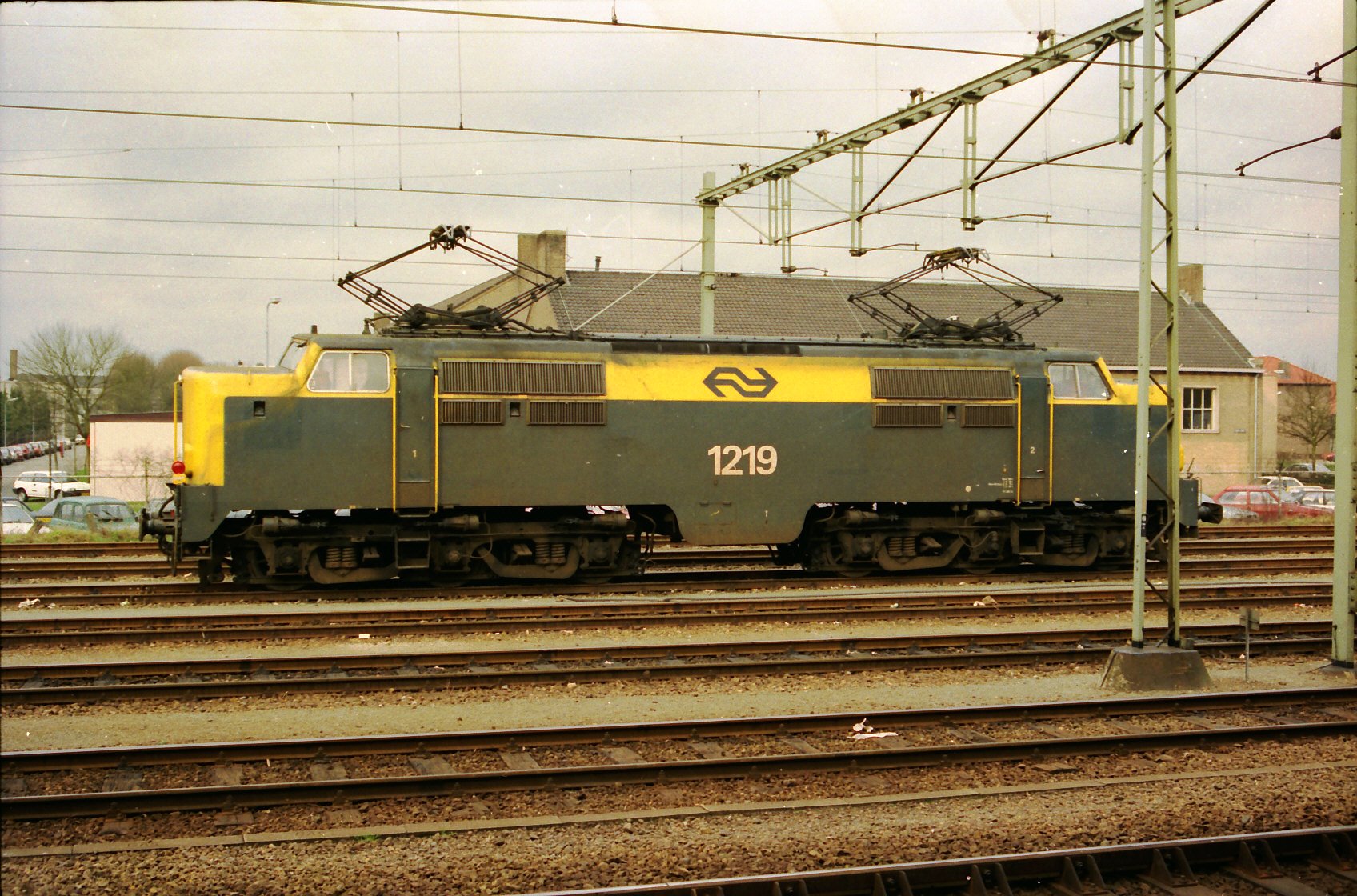
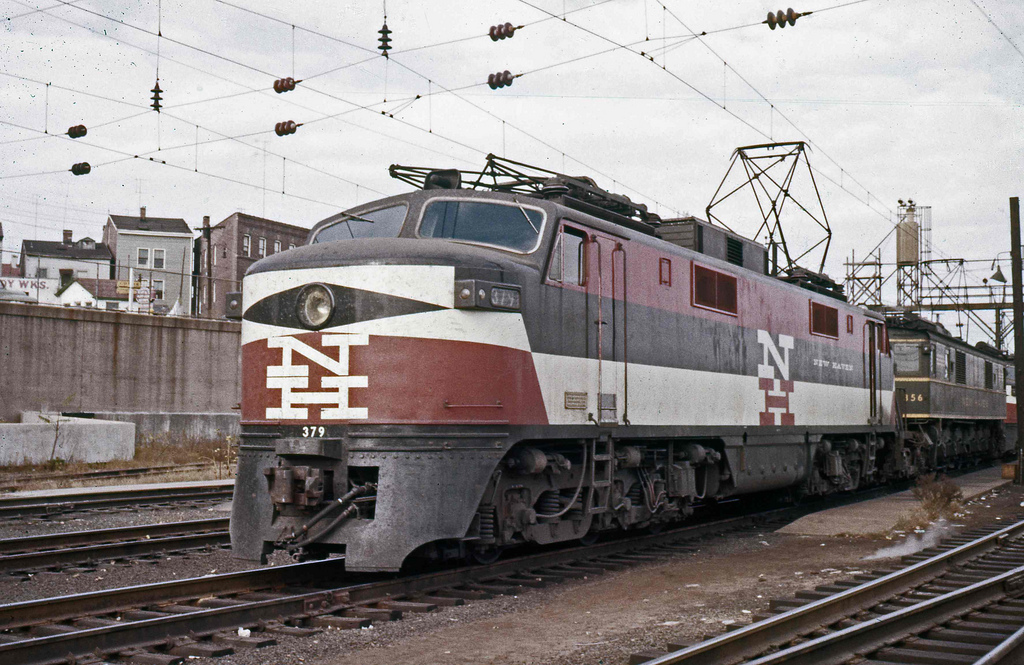
One of the better looking post-war US electric locomotives, the New York, New Haven & Hartford Railroad EP-5. Launched from 1954, this was a complex piece of equipment for its day. GE got the order for ten of these from a cash-strapped New Haven and in order to do the best job possible, they convened a committee of electric traction specialists (no doubt by then out-of-work Westinghouse people included) to analyse the problems with the Baldwin/Westinghouse E2c and E3b ignitron rectifier locomotives for the Pennsylvania Railroad, the “Westinghouse Rectifiers”, and look at ways to avoid running into the same problems again. One of the issues on those Westinghouse loco’s was the heat generated and the problems encountered to dispel it. Things would not be easier for the 2.98 mW proposed NH machines, which would have to deal with 11 Kv 25 Hz and 60 Hz AC as well as 600 v DC. In order to get an idea about the best lay out for these loco’s the designers came across the 1948 design for the above very similar Dutch loco’s. It was instantly clear that for the jobs proposed only a double-ender would do, as was in fact the case on all the New Haven and Pennsy electrics bar the for freight conveyance designed Westinghouse and GE experimentals of 1945. This meant, however, that like the ignitron rectifier experimentals, this AC-DC rectifier once again would be a rather well-stuffed machine, as not only would a big transformer with tap-changer but also 12 (2 per traction motor) ignitron mercury-vapour rectifiers need to find a place, as well as resistance banks to control the locomotive on the 600 V DC track in the New York area on the way to NY Central station rather than Penn station. And the six DC traction motors did their bit to generate heat, whereby on top of it all two cabs instead of one needed to be included in a none too generously spaced body. Which left no generous empty rear-end where some of the electric kit and cooling equipment could find a place. As a result these locomotives, however good they were at their job, had a tendency to overheat, especially in the Park Avenue tunnels under Manhattan, despite the powerful ventilation equipment installed that challenged the hearing of those on platforms when these machines passed by. Their nickname “Jets”, (straalvliegtuigen), says it all. And yes, more than once they set themselves alight. Their history reads like wobbling from crisis to crisis, hiding the fact that they were actually rather good at their job. Had, for instance, silicon rectifying equipment been available (or installed during an overhaul later in the 1960’s) it is doubtful that these machines would have had the problems they encountered with their installed kit. And the history of electric passenger traction on the Northeast Corridor would then have looked markedly different: it is doubtful that the GE-built Amtrak E-60 would have ever had a chance. All these machines were out of use in 1977 and by 1979 they were all scrapped. For a small but technically and design-wise very influential railroad like the New Haven it is remarkable that none of their traction appears to have been set aside for a museum. For this machine one needs to go to Chile or The Netherlands to get an idea of what they kind of looked like, for the EP-4 one needs to visit Chile or Brazil to find spin-off examples and the EP-3, one of which with number 156 is visible behind 379) is plain history to the best of my present knowledge. But, again, look at the details of number 379. The trucks are kind of similar to the regular drop-equalizer bar trucks of the 1200, but not quite. The weight of the loco is evident in the fact that extra primary coil springs were added at the very end of the trucks. For a machine with known heat-management problems, look at the (later added, after fires) comparatively small ventilation grilles in the sides. The main ventilation takes place through that box on the roof, where in the tunnels the ambient summer heat congregates as well. Find the DC pick-up shoes and shoe-fuse boxes at the inner ends of the trucks. And those little square flap-covered entrances either side of the bodyside ventilation grilles, are these the sand-filler openings? See the tightlock coupler with the brake and main reservoir pipes and the speedometer connection going up into the cap from the axlebox nearest to us. Most of all, the red/light grey and black Patrick McGinnis colour scheme that a present Dutch operator tried (but failed) to emulate on a 1200. And the Raymond Loewy set up of marker and reporting light clusters either side of the headlight. And what a lovely, clear picture; I dearly wish I could have made that.
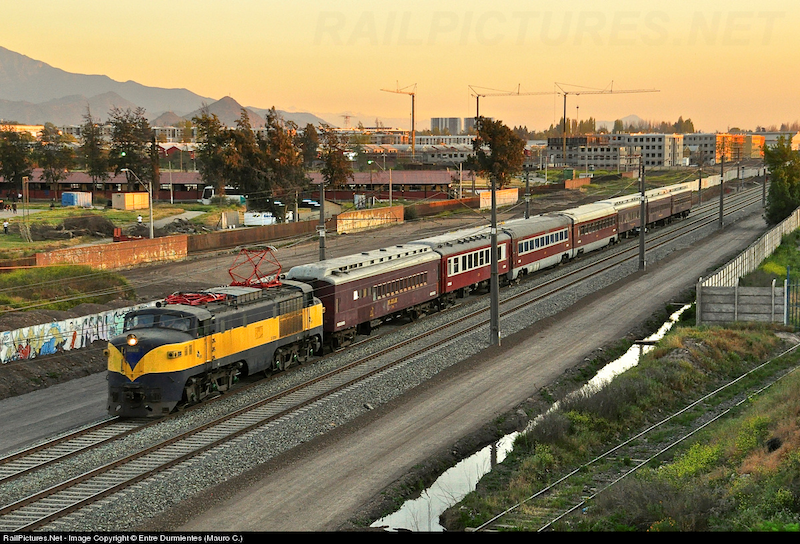
Chile, the Ferrocarriles Del Estado de Chile. The machine shown is an E-32 Co’Co’, meant primarily for freight. The Bo’Bo’ passenger variety could be seen on an earlier picture I sent of an E-30 and an E-29 (the NH EP-4 clone) awaiting their next assignment. There are a number of things that tell me that this is most likely a special, like we see them running on Netherlands Railways with the 1200. Given that a) I read that long-distance passenger rail-traffic is virtually defunct in Chile, given that b) this is clearly a site where a city is being extended into further suburbia, and c) given that the tracks have been most thoroughly done up and look spiffing, a credit to messrs Plasser & Theuer, never mind that the train is d) composed of at least three generations of suspiciously clean looking rolling stock where normally one saw trains lashed up from one type of, but much dustier, coaches, I can’t be very far amiss with that assessment. Obviously, the fact e)that someone was train-mad enough to sit there in the setting sun to take a picture of a train is a further indicator. But look at the locomotive and scroll forward and back from notably the NH EP-5. Well, this machine is Italian-built and far and wide advertised as such: General Electric or Westinghouse, let alone Baldwin, are nowhere mentioned. But look at those markerlight/reporting light clusters, the clearly US drop equalizer bar trucks, that ever so US stairway to heaven right where the PRR E2c and E3b and the RENFE 278 have it, and most of all where NS 1200 would have had it had Baldwin had its wicked way and a detail like that ventilator box on the roof. This has very little to do with Italy per se, they built absolutely completely different loco’s there. This machine has everything to do with Baldwin, Westinghouse, General Electric, the New Haven and Pennsylvania Railroads and the Italian builders just had the honour of putting the machines together. Despite their nickname “Gina Lollobrigida’s” due to their well-rounded front ends, they really are mainly New Haven EP-5’s. The history is in the book, on which I’m working now to rewrite it is English.
 Another bit of Ruminating on Railways